

The meeting was attended by Deputy Prime Ministers, leaders of ministries, sectors, and agencies under the Government.
The meeting provided comments on the policy dossier of the Law on E-Commerce, prepared by the Ministry of Industry and Trade, as well as several other important matters. Previously, on the evening of June 16, the Government Standing Committee also gave opinions on four other draft laws in preparation for the Government’s thematic law-making session in June.
Delegates heard presentations from the drafting agencies and focused their discussions on the provisions and policy groups within the draft laws and dossiers, particularly on the contents to be removed, revised, and refined; provisions to be added; administrative procedures to be reduced and simplified; decentralization and delegation of authority; issues with differing opinions; other matters requiring reporting; and the expected timeline for submission to the National Assembly.
Regarding the policy dossier of the Law on E-Commerce, Prime Minister Phạm Minh Chính emphasized that this is a highly important draft law. It must institutionalize and concretize the Party and State’s major guidelines and policies, especially the recent Politburo resolutions on the “four key pillars,” including the acceleration of digital transformation, development of the digital economy, digital society, and digital citizens, removal of legal bottlenecks, and promotion of private sector development.
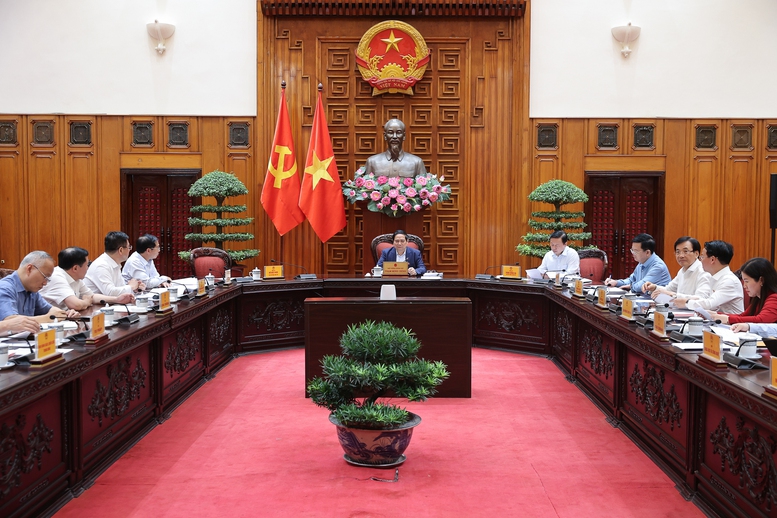
The Prime Minister emphasized that the requirement is to both ensure effective management—guaranteeing fair competition, equal access among stakeholders, and effective tax administration—and to promote development, fostering production and business activities, creating jobs and livelihoods for citizens and enterprises, while also addressing negative and harmful aspects, preventing counterfeit and fake goods as well as smuggling; and ensuring policies are appropriate for household businesses, small enterprises, and micro-enterprises.
He also noted the need to clearly define the responsibilities of relevant agencies and to apply technology and digital transformation in governance; to promote decentralization and delegation of authority in parallel with appropriate resource allocation, strengthen implementation capacity at lower levels, and design tools to enhance inspection, supervision, and control of power.
Ha Van
Nguồn: https://baochinhphu.vn/thu-tuong-luat-thuong-mai-dien-tu-can-vua-quan-ly-duoc-vua-kien-tao-phat-trien-10225061720061339.html