

The Law on Organization of Local Government (amended) reflects an innovative mindset aimed at modernizing local governance, promoting developmental governance, removing “bottlenecks,” and unlocking resources to meet the goals of rapid and sustainable growth of localities in particular and the country as a whole in the new era.
The development of this Law also carries great historical significance, establishing a solid legal foundation for the organization and operation of local government under the two-tier local government model, which is being implemented for the first time in Vietnam.
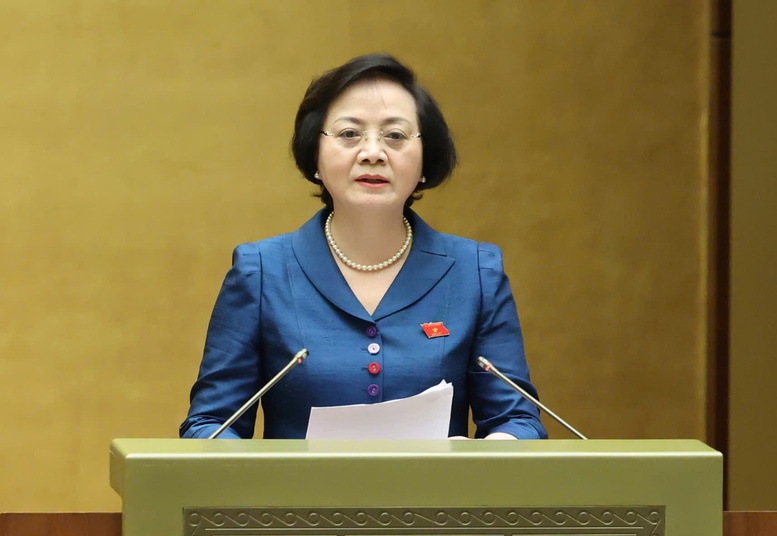
Previously, in presenting the report on the absorption, revision, and finalization of the draft amended Law on Organization of Local Government, Minister of Home Affairs Phạm Thị Thanh Trà stated that the draft Law establishes a two-tier local government model (provincial and commune levels) applied uniformly nationwide, clearly defining the tasks, powers, and organizational structure of each level of government; and provides a comprehensive legal basis for the model of local government in special administrative-economic units.
At the same time, incorporating opinions from National Assembly deputies, the Government has revised and supplemented provisions on administrative units, as well as principles for the organization and operation of local government, ensuring streamlined, efficient, effective, and people-centered governance. It emphasizes the principle of “localities decide, localities implement, and localities take responsibility,” thereby promoting the initiative, creativity, autonomy, and accountability of local governments.
A strong reform step, enhancing the responsibility of leaders
Regarding the definition of authority, decentralization, delegation, and authorization, in order to institutionalize the directions of the Central Committee, the Politburo, and the Secretariat, the draft Law has improved the principles for defining authority between central and local governments, and between provincial and commune-level governments in a scientific, synchronized, and consistent manner. It clearly distinguishes the authority between collective People’s Committees and individual Chairpersons of People’s Committees, enabling flexible and effective governance and encouraging initiative and creativity of leaders in local state administrative agencies.
At the same time, based on feedback from National Assembly deputies, the Government has revised and supplemented regulations on decentralization, delegation, and authorization. Notably, it has added new actors for decentralization, including the People’s Council and the Chairperson of the People’s Committee at provincial level; introduced mechanisms for monitoring, evaluation, and supervision to timely adjust decentralization and delegation content; and empowered Chairpersons of provincial People’s Committees to directly direct and manage issues under the jurisdiction of specialized agencies and administrative bodies at their level, as well as commune-level People’s Committees and their Chairpersons, ensuring that administrative procedures and public services for citizens and businesses are not delayed, congested, or inefficient.
Regarding the tasks and powers of local governments, based on the principles of authority allocation, the draft Law comprehensively redesigns the tasks and powers of the two-tier local government system (provincial and commune levels), ensuring clear delineation without overlap or duplication of responsibilities. This aligns with modern local governance models and provides a legal basis for specialized laws to define specific tasks and powers of local governments at both levels in various sectors.
Incorporating opinions from National Assembly deputies, the Government has reviewed and revised provisions regarding provincial and commune-level governments as follows: adjusting certain tasks and powers from People’s Committees to Chairpersons of People’s Committees (provincial People’s Committees have 12 groups of tasks and powers; provincial Chairpersons have 23 groups; commune People’s Committees have 10 groups; commune Chairpersons have 17 groups); and adding provisions allowing Chairpersons of People’s Committees to decide on matters under the authority of People’s Committees (except those requiring collective deliberation), and to report to the People’s Committee at the nearest meeting.
“This is a strong reform step aimed at enhancing the responsibility of the head of the executive agency, creating momentum for innovation in local governance. Accordingly, these provisions ensure proactiveness, creativity, flexibility, and greater accountability of Chairpersons of People’s Committees, improving the effectiveness and efficiency of local state administration in line with practical requirements,” Minister Phạm Thị Thanh Trà emphasized.
Regarding the organization and operation of local governments, the draft Law combines selective inheritance with innovation to improve the institutional framework for the two-tier local government model.
At the same time, incorporating opinions from National Assembly deputies, the Government has further refined these provisions, specifically: stipulating that commune-level People’s Councils have two committees (the Economic-Budget Committee and the Culture-Social Committee); maintaining the number of provincial and commune-level People’s Council deputies within the prescribed minimum and maximum ranges (Hanoi and Ho Chi Minh City have 125 deputies each); and introducing a principle in the draft Law that “the Chairperson, Vice Chairpersons, Heads and Deputy Heads of Committees of provincial and commune-level People’s Councils, and members of provincial People’s Council committees, may be full-time deputies,” while assigning the Standing Committee of the National Assembly to specify the number of full-time positions. This ensures flexibility and suitability to the practical conditions of the country and localities at different stages of development, or when new policies are issued by competent authorities, without requiring amendments to the Law.
Ensuring the smooth and effective operation of the two-tier local government model from July 1, 2025
Regarding the resolution of issues related to the transition of the local government model from a three-tier to a two-tier system, the Minister of Home Affairs emphasized that this transition is an important reform with historic significance. To ensure continuity, smoothness, and stability during this process, the draft Law provides comprehensive provisions that anticipate practical issues that may arise, ranging from organizational structure, personnel, and administrative procedures to operational mechanisms.
At the same time, based on the opinions of National Assembly deputies and pursuant to Conclusion No. 167-KL/TW dated June 13, 2025 of the Politburo and the Secretariat, the draft Law has been revised and supplemented with the following provisions: transitional arrangements for wards in Hanoi, Ho Chi Minh City, and Da Nang that are currently operating under the urban government model (where only People’s Committees are established, without People’s Councils) to transition to a full local government model (with both People’s Councils and People’s Committees), ensuring smooth and effective operation starting from July 1, 2025.
The draft Law also provides transitional provisions for the handover of work, resolution of administrative dossiers, and handling of administrative procedures from district-level local governments after their termination, ensuring no disruption to administrative processes and no impact on the normal functioning of society, citizens, and businesses.
In particular, in order to promptly address unforeseen and emerging situations not yet regulated by law, the draft Law establishes a flexible and proactive mechanism allowing the Standing Committee of the National Assembly, the Government, the Prime Minister, Ministers, heads of ministerial-level agencies, and People’s Councils and People’s Committees at provincial level to review and issue, or authorize the issuance of, legal documents to resolve issues arising during the organization of provincial and commune-level local governments under this Law. This provision is based on the inheritance of regulations under Resolution No. 190/2025/QH15.
Thu Giang