


Each citizen needs to understand that the merger of provincial-level administrative units does not mean the loss of local identity, but rather the elevation of local development. It is not the erasure of history, but the continuation of a new chapter with a larger scale and higher stature. This is a time for the entire people and the entire Party to act together for the national and collective interest, for a more streamlined, stronger, and more powerful Vietnam in the 21st century.
Why is provincial merger necessary?
Previously, Vietnam had 63 provinces and centrally governed cities—a rather unusual number compared to the country’s population and territorial scale. This administrative structure was formed under specific historical circumstances, but over time it has revealed clear limitations and has become a major constraint on the efficiency of state governance as well as national productivity.
Many provinces are too small to develop independently, with populations of under one million people, and in some cases only 300,000–400,000 residents. These provinces often have low budget revenues, fragmented infrastructure, and a high level of dependence on central government transfers.
The administrative apparatus is also overly dispersed, with each province maintaining a full set of departments and agencies. This leads to duplication of functions, overlapping responsibilities, and continuously rising administrative costs.
In addition, rigid administrative boundaries are significantly hindering regional planning, inter-provincial infrastructure development, and the optimization of value chains across economic spaces.
Meanwhile, Vietnam is entering a new phase of deep development—where growth can no longer rely on natural resource exploitation or low-cost labor, but must instead be driven by productivity, innovation, digital transformation, and effective regional linkages.
These objectives require administrative units with sufficient scale to enable long-term planning, attract strategic investment, organize development space, and coordinate flows of capital, labor, and technology across regions.
The current small and fragmented administrative model is no longer capable of supporting new development strategies. Provincial merger is therefore a way to redesign administrative units to meet the demands of the new era.
More than ever, the present moment brings together all necessary conditions for action. Politically, Resolution No. 60-NQ/TW clearly sets the direction: administrative units must be large and strong enough, eliminating prolonged weak and dependent provinces. Legally, the National Assembly is in the process of finalizing decisions. Socially, public trust and expectations for reform are high: citizens expect a more efficient public administration system, while businesses demand simplified procedures, streamlined administrative layers, and a more transparent investment environment. Political and social consensus has matured. If action is not taken now, this historic opportunity will pass, and the country will continue to be constrained by an administrative design that is no longer suitable for its new developmental stature.
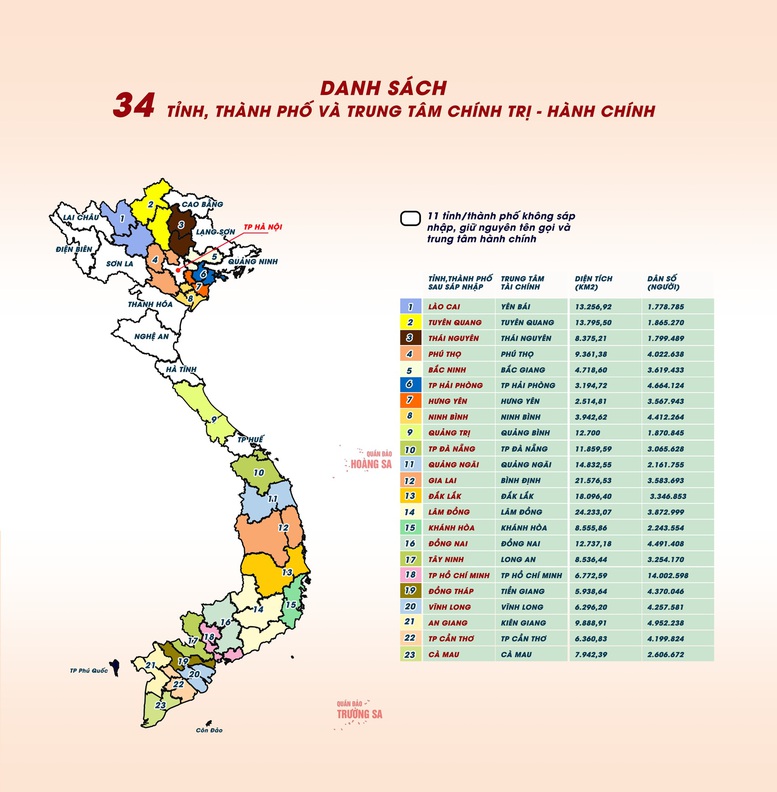
Specific benefits of reducing administrative units to 34 provinces
The merger of provinces is not merely an administrative reform; it is a powerful lever for creating administrative units with sufficient scale, development capacity, and connectivity.
First, it provides the necessary conditions to form new growth poles on the regional development map. The newly formed provinces will create integrated development spaces connecting central urban areas, coastal regions, deltas, and mountainous areas, thereby enabling a complete production–logistics–consumption–export value chain. For example, the former Can Tho alone had a GRDP of about VND 140,000 billion (2023), but if merged with two neighboring provinces, the combined GRDP could exceed VND 250,000 billion with a population of over 3.5 million—comparable to a mid-level industrial province in Thailand.
Second, reducing the number of provinces from 63 to 34 will lead to a comprehensive restructuring of the administrative apparatus, helping streamline organizational structures and significantly reduce operating costs. Previously, each province had an average of 20–22 departments and agencies. Estimates by experts suggest that this streamlining could save thousands of billions of VND annually in salaries, recurrent expenditures, and office infrastructure costs. More importantly, these saved resources can be reinvested into infrastructure, education, healthcare, and digital transformation—areas that have strong spillover effects on social productivity.
Third, larger provinces will have stronger capacity for systematic planning, more effective economic policy implementation, and greater competitiveness in attracting investment. According to the Provincial Competitiveness Index (PCI) 2024, provinces with strong inter-regional coordination such as Quang Ninh, Hai Phong, and Long An consistently rank among the top performers. In contrast, smaller provinces with weak connectivity and limited regional planning tend to lag behind. Larger provinces are not only better positioned to negotiate with strategic investors but also more attractive to multinational corporations, which typically require large-scale markets and infrastructure.
Fourth, mergers enable more efficient budget utilization and higher public investment productivity. A study published in SAGE Journals (2021) shows that every 1% increase in public investment expenditure, if properly allocated, can increase provincial GRDP by approximately 0.196%. Maintaining too many small provinces currently leads to fragmented budgets and dispersed investments with low efficiency. When consolidated, projects can be more selectively prioritized, capital resources better concentrated, and management improved, thereby enhancing public spending efficiency.
Fifth, larger provinces have superior advantages in organizing regional development space and coordinating inter-provincial infrastructure. Currently, transportation between Ho Chi Minh City and Binh Duong—only about 40 km apart—can take nearly two hours during peak hours due to a lack of integrated infrastructure planning. Coordination among provinces in transport, logistics, and urban drainage planning remains weak and constrained by administrative boundaries. With mergers, many infrastructure projects will no longer be “cut apart” by jurisdictional borders, thereby improving governance capacity, ensuring planning synchronization, and enabling more efficient resource utilization.
Finally, provincial mergers are also an effective tool for promoting balanced regional development. Linking mountainous provinces such as Kon Tum and Gia Lai with coastal provinces such as Quang Ngai and Binh Dinh will open opportunities for inter-regional logistics corridors, green–cultural–ecotourism routes, and high-value agro-forestry processing industries. This not only strengthens regional connectivity but also gradually narrows the development gap between regions nationwide—one of the core objectives of sustainable and inclusive development policy.
Implementation must be synchronized and systematic
The merger of provinces is not merely a technical decision, but a strategic political action—reflecting the reform capacity of the Party, led by General Secretary Tô Lâm, as well as the development vision of the National Assembly and the Government, and the aspiration for national advancement. However, to ensure both speed and stability, implementation must be systematic, synchronized, and carefully prepared.
First, the administrative apparatus must be reorganized toward a streamlined but effective structure. The restructuring of agencies, arrangement of headquarters, allocation of personnel, and settlement of policies for redundant officials must be carried out in a transparent, fair manner, without causing social disruption.
Second, the implementation roadmap must be clear and feasible. The short timeframe requires strong and decisive direction from the central level, along with serious and responsible engagement from local authorities.
Third, social communication must be proactively guided. It is necessary to clearly communicate that provincial mergers are aimed at creating administrative units of sufficient scale to enable stronger and more sustainable development.
Finally, digital transformation must be placed at the center of the restructuring process. Digital data systems, e-governance platforms, and intelligent monitoring tools will enable the new administrative apparatus to operate efficiently, transparently, and in an interconnected manner, rather than merely changing geographical boundaries without improving governance capacity.
Acting together for the national interest
The success of this reform will serve as evidence of the Party, the National Assembly, and the Government’s capacity for innovation and decisive leadership—those who are willing to break from outdated thinking and confront obstacles to pave the way for a more sustainable and comprehensive development future. However, for this reform to truly take effect in practice, it requires unity, consensus, coordination, simultaneous action, and collective effort from the entire political system—from the central to the grassroots levels—as well as from every cadre, Party member, and especially the people.
Dr. Nguyễn Sĩ Dũng